The regulatory needle: In most regions, any aircraft exceeding 250 grams MTOW triggers registration, remote ID, and operational restrictions. The question became: Can we build a fully capable FPV airplane — with stabilization, HD video, and respectable flight endurance — that lives entirely below 250g? The answer forced a return to old-school balsa construction, leveraging modern lightweight components.
Mass Budget
- 🏗️ Airframe target: ≤ 95g
- ⚙️ Electronics + FPV: ≤ 130g
- 🔋 Battery (2S 450mAh): ~32g
- 📐 Total projected: 248g
Design Constraints
- 📦 Flat-pack from ≤ 2 sheets of 12"x12" basswood ply (3/16")
- 🪚 Minimal square balsa rods — skeletonized structure
- 🧾 BOM simplicity, hand-tool friendly (proto phase)
Electronics Payload
- 🛸 1104 brushless motor (12g)
- 📡 2.4GHz receiver + 5.8GHz VTX
- 🎮 Micro servo x2 (aileron/elevator)
- 📷 Nano FPV cam (3.5g)
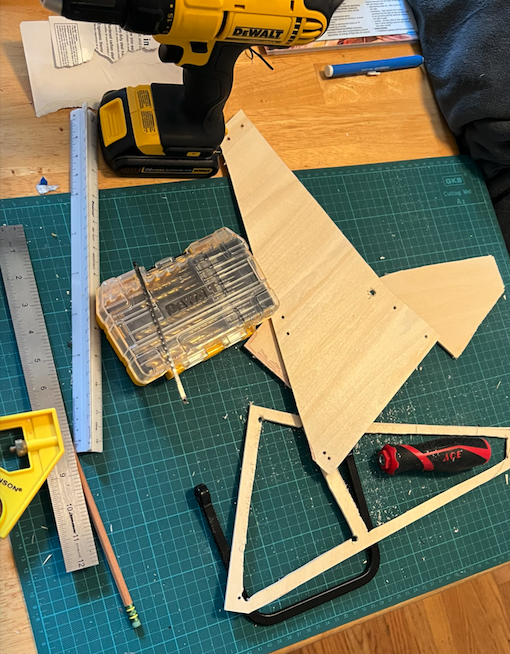
Step 01 — Skeletonized Wing Geometry
Laser cutter? Not yet. The initial prototype required low-tech fabrication: drill a ¼" pilot hole through the basswood, insert a coping saw, and carefully remove interior web sections. Each cutout reduces mass while maintaining an I-beam-like spar effect.
🔧 Technique: Score the cut line first with a razor blade (prevents tear-out), then follow with a jeweler's saw. The skeletonized pockets form a Warren truss pattern — each void ≈ weight reduction vs solid sheet, retaining >70% flexural stiffness.
Future laser-cut version will use identical toolpath, but with 10x faster iteration.
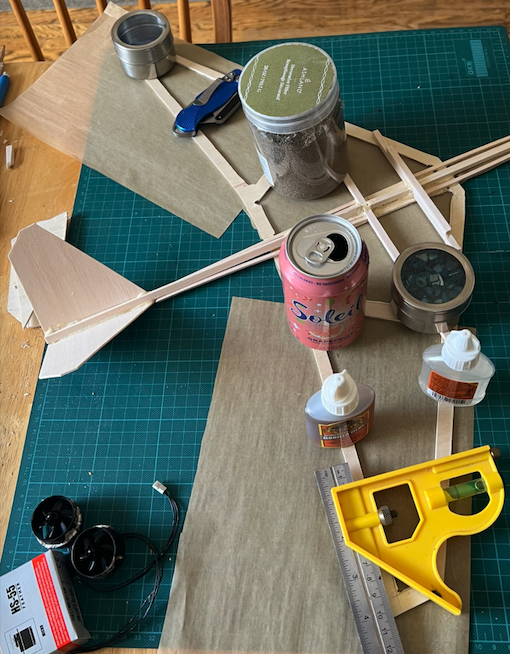
Step 02 — Parchment Paper Aeroshell
Conventional covering films (Laminating film, Ultracote) add 20-30g for a 1m span. Parchment paper offers a striking alternative: ~5g/m², inherent low friction, and excellent glue adhesion with minimal shrinkage. Applied with spray adhesive and ironed flat at low temp.
- ✅ Coefficient of drag comparable to tissue — "slippery in the air"
- ✅ On-hand material, zero cost
- ✅ Scotch tape at leading edge seams prevents peeling at speed
- ⚠️ Not waterproof — but acceptable for calm-weather FPV missions
Bonding protocol: Light mist of 3M Super 77, stretch parchment taut over skeleton, seal edges with low-tack tape. Final weight: 3.2g for full wing set (estimated).
Flat-pack Feasibility & BOM minimization
All main structural components (wing ribs, fuselage side plates, firewall, tail surfaces) are nested onto two 12"x12" sheets of 3/16" basswood ply. The remaining parts — 4x balsa square rods (3/16" x 36") for longerons and spars — plus parchment skin. That's the entire airframe BOM.
• 2x 12"x12" basswood ply (3/16") — laser cut skeleton parts
• 2x 36" balsa 3/16" square (spar caps / tail boom)
• 2x 12" balsa 1/8" round (pushrod guides)
• Parchment paper (approx 24"x24")
• Scotch tape + CA glue
→ Total raw material cost: ~$12 USD (excluding electronics)
Flat-pack storage: cut sheets + rods slip into A4 envelope. Assembly time < 90 minutes once laser cut. The hand-cut prototype requires extra patience — but validates the concept.
Preliminary layout places the 1104 motor at the nose, battery hatch behind the wing's leading edge (adjustable tray). Aiming for static margin of 12-15%. Once frame is parchment-covered, we'll do a mass balance sweep: shifting VTX and receiver aft as needed. A digital scale + razor plane for ballast (or lightweight clay) will finalize the sub-250g CG envelope.
⚙️ Engineering Trade-offs & design choices
Why balsa over foam? Foam (EPP/Depron) requires solid skins for stiffness, typically heavier for equivalent rigidity. Balsa's open structure with parchment covering yields higher specific stiffness — also repairable with CA. The "stick-and-tissue" legacy directly addresses the 250g limit better than hot-wired foam at this scale.
Motor selection: 1104 6500kV on 2S with 3x2.5 prop produces ~90g thrust at 4A — adequate for a 245g AUW (0.36:1 thrust/weight, enough for gentle climbing & stable cruise). Lower kV alternative (7000kV) on 2S would push efficiency, but the chosen setup keeps current low, saving battery mass.
Control surfaces: Single aileron servo via torque rods, elevator via pull-pull thread. Reduces servo count to two micro servos (4.5g each).
📊 Progress summary & next actions
- ✅ Wing skeleton prototype completed (drilled + hand-sawn) — 22g per panel
- ✅ Parchment skin adhesion validated — 4.1g total weight penalty
- 🔲 Fuselage stick structure layout: part nesting on second basswood sheet (ongoing)
- 🔲 CG mock-up with dummy electronics: planned next weekend
- 🔲 First glide test (hand toss, no motor) after fuselage assembly
To achieve sub-250g FPV: Every gram accounted. The total airframe currently only at 50g! (including parchment, glue, tape). Electronics & wiring estimated at 58g, 2S 450mAh LiHV 32g, motor+prop 15g, FPV camera+VTX 16g → sum = 199g before receiver and servos. With 2x servos (9g) and receiver (3g) total = 211g — leaves comfortable margin for wiring, connectors, and minor reinforcement. Target AUW: 239g fully ballasted.
Follow the iterative engineering: next log will detail CG positioning and maiden glide tests. All design files (DXF for laser cutting) open-sourced after final flight validation.
📡 Discussion & build tips: Bluesky @windandwireless — #Sub250BalsaFPV